
With populations aging and chronic diseases surging, health systems everywhere face a watershed choice: cling to the status quo or reinvent what successful care looks like. At the Second Asia-Pacific Healthcare Quality Forum, Jennifer L. Bright, President and Chief Executive Officer of the International Consortium for Health Outcomes Measurement (ICHOM), issued a clear challenge in her keynote speech: to create real value, health systems must measure outcomes that matter to patients.
Bright highlighted that global healthcare spending is projected to increase from 9.2% of GDP in 2022 to 11.8% by 2040. Yet higher investment does not automatically lead to better health. Bright noted that chronic diseases alone could cause global economic losses up to US$47 trillion by 2030, exposing a serious imbalance in our healthcare model.
Her question to hospitals was simple—but uncomfortable: “Does healthcare truly make patients’ lives better?”
Medical resources are strained, and new technologies emerge rapidly. Focusing on patient outcomes can seem like an added burden. However, Bright argued that placing outcomes at the center of decision-making helps recalibrate health systems so care is not only about extending life but also enabling people to live better.
Today, the measurement of healthcare “outcomes” remains uneven and nontransparent. As a result, institutions struggle to compare performance across borders or learn from peers. Effective care models remain isolated and rarely reach the places that need them most.
To close this gap, ICHOM has become a key driver of the worldwide transition toward value-based healthcare, building on a framework introduced by management scholar Michael Porter. At its core is a deceptively simple formula:
Value = Outcomes that matter to patients ÷ Costs and resources required
Under this model, health systems create more value when they achieve better outcomes at lower cost.
Bright emphasized that “outcomes” should not be constrained to traditional clinical metrics such as survival rates or complications.
Instead, they must capture patients’ quality of life: their ability to regain function, return to daily activities, and improve psychological and social well-being. Making these aspects visible is the only way for health systems to know if patients truly feel the benefits of care.
Over the past 14 years, ICHOM has developed standardized outcome measurement sets for 48 diseases, covering nearly 60% of the known global disease burden. Its work continues to expand into areas such as adult obesity and heart valve disease.
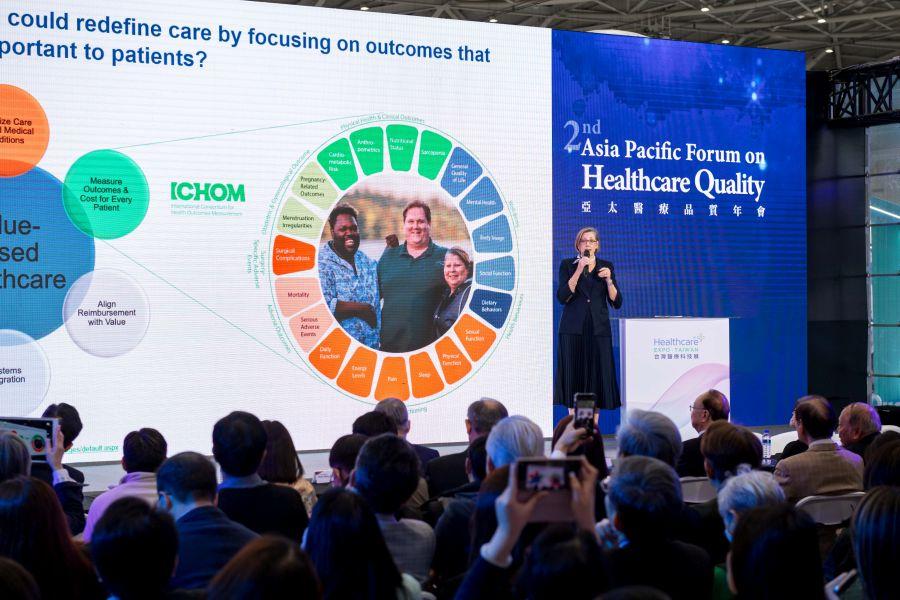
Each ICHOM measurement set includes core components: baseline patient data, Patient-Reported Outcome Measures (PROMs), data sources, validation tools, and data collection time points. Taken together, these designs ensure that outcomes can be meaningfully compared across countries and health systems.
Bright illustrated the impact of this approach through international case studies, showing that patient outcomes underpin both quality improvement and cost control.
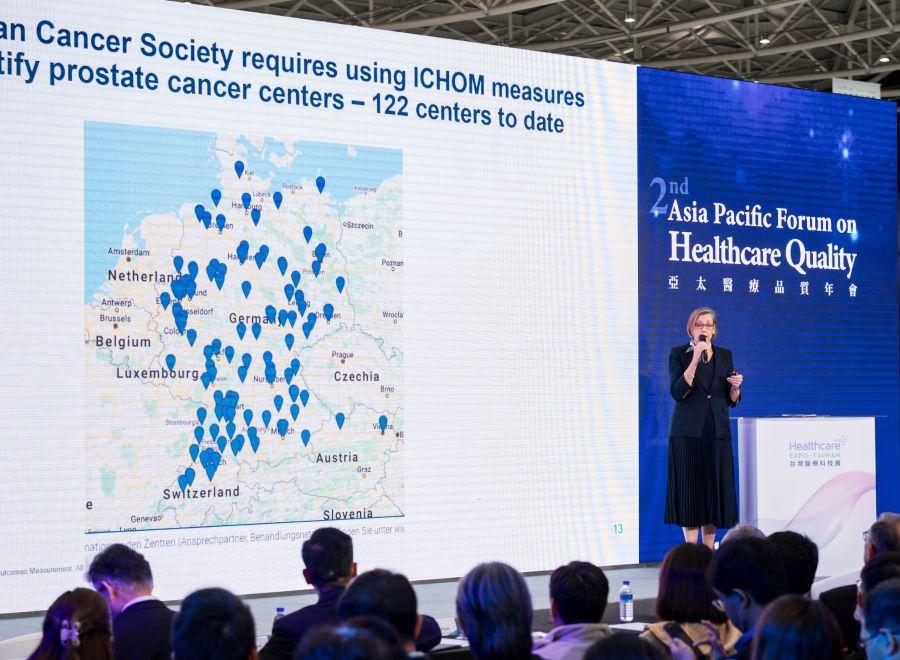
At Germany’s Martini Klinik, an academic center affiliated with the University of Hamburg, around 2,500 prostatectomies are performed every year. While five-year survival rates matched the national average, patients were especially concerned about functional outcomes such as urinary incontinence and erectile dysfunction.
When the hospital adopted PROMs and gained a better understanding of patients’ experiences, it identified and discontinued lower-performing surgical techniques. This led to clear improvements in patients’ quality of life. Today, 122 medical centers across Germany use ICHOM measurement tools.
In Mexico, the diabetes care organization CaiPaDi adopted ICHOM standards and saw significant benefits. Per-patient care costs fell by nearly 80%, while patients’ anxiety levels dropped by 50%. Clinical indicators—including blood glucose, blood pressure, and low-density lipoprotein (LDL) cholesterol—also moved closer to normal ranges. Outcome-focused care clearly improves quality while reducing costs.
Bright also spotlighted examples from Ghana and Zimbabwe, where healthcare providers successfully implemented maternal health and diabetes PROMs despite limited resources. These initiatives demonstrated that even with constraints, health systems can track patient-reported outcomes and measurably improve both care quality and quality of life.
Bright pointed out that SNQ (Safety and Quality) - Taiwan’s Safety & Quality Certification System has long integrated outcomes into its quality certification framework. Beyond assessing structure and process, SNQ also incorporates patient satisfaction as an important indicator.
This approach mirrors ICHOM’s philosophy and positions SNQ as a strategic platform linking Taiwan to the global movement toward patient outcome–driven healthcare. As a result, by embedding outcome considerations into certification, SNQ enables hospitals in Taiwan to align with international value-based care practices.
Adopting outcome-oriented quality assessment can appear complex, but Bright’s message was pragmatic: What matters most is to “start small, and simply start.”
Making patient outcomes visible and comparable is essential. Measuring them carefully and committing to value-based care helps hospitals do more than treat conditions; they help transform lives.