
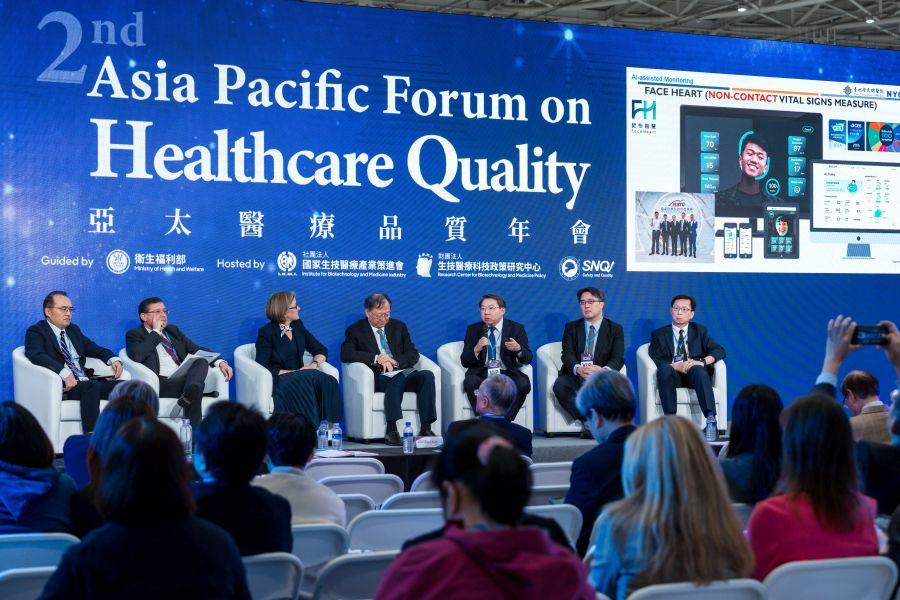
Artificial intelligence is no longer a distant promise in medicine—it is actively reshaping the clinical landscape. At the recent Asia-Pacific Healthcare Quality Forum, hospital executives and patient advocates from the United States, Europe, and Taiwan gathered to explore how AI is transforming daily operations, and what hurdles still stand between successful pilot programs and routine clinical adoption.
Enhancing Patient Care: From Smart Lighting to Non-Contact Monitoring
In northern Taiwan, Dr. Liang-Kung Chen, Superintendent of Taipei Municipal Guandu Hospital, visualizes his community hospital as a "lighthouse" for the local population. By leveraging AI to coordinate services across wards, private homes, and community centers, the hospital successfully extends its continuum of care far beyond traditional clinical walls.
A prime example is the hospital’s implementation of smart lighting in its behavioral health units. Dr. Chen noted that the system automatically adjusts illumination levels throughout the day to mimic natural circadian rhythms, which has improved residents’ sleep quality by an impressive 52 percent. To bolster patient safety, Guandu Hospital also introduced smart mattresses paired with a dedicated monitoring app—a combination that has drastically reduced bedside falls and pressure injuries.
At larger tertiary centers like Taipei Veterans General Hospital (TVGH), AI deployment has moved toward non-contact monitoring. According to Dr. Wui-Chiang Lee, Deputy Superintendent of TVGH, the hospital has adopted FaceHeart , an AI-assisted system that utilizes facial recognition technology to track patients’ physiological signs and mood indicators.
“The system has been successfully applied in both inpatient units and home-care settings,” Dr. Lee noted.
This is just one piece of TVGH's broader AI portfolio, which spans internal medicine specialties to include heart failure management, pulmonary hypertension tracking, liver cancer diagnosis, endoscopic image analysis, and renal anemia prediction.
The Patient-Centric Metrics of Digital Health
Jennifer L. Bright, President and CEO of the International Consortium for Health Outcomes Measurement (ICHOM), emphasized that the true measure of any AI tool lies in its clinical relevance.
“While digital platforms can now track patient-reported data in real time, long-term success depends entirely on choosing the right metrics,” Bright argued. She added that involving patients in the design of digital architecture naturally drives engagement and fosters trust—especially when that data is transparently shared back with them.

Representing the European perspective, Oscar Gaspar, President of the European Union of Private Hospitals, highlighted the shifting regulatory landscape. He pointed to the European Health Data Space Regulation as a critical framework for ensuring patients maintain seamless, secure access to their own electronic health records.
Meanwhile, Dr. C. Jason Wang, Director of the Center for Policy, Outcomes and Prevention (CPOP) at Stanford University, added a pragmatic economic note from the US perspective, reminding the forum that in the United States, patient insurance coverage and reimbursement models must always be factored into the deployment of smart medical technologies.
Clinical Optimization: Accelerating Diagnosis and Streamlining Workflows
Recognizing their distinct institutional strengths and limitations, hospitals are tailoring their AI integration strategies to fit their unique operational models.
TVGH has found massive success through strategic partnerships with global tech giants to acquire cutting-edge computational power. Collaborating with NVIDIA, the hospital deployed Clara Parabricks pipelines to accelerate secondary genomic analysis. A processing task that traditionally required 32 hours of computing time now takes just 1.2 hours—a staggering 96 percent reduction.
To combat the pervasive issue of clinician burnout, TVGH also partnered with ASUS to engineer a generative AI documentation tool. The system has plummeted the time required to complete inpatient medical records from 7.5 minutes to a mere 25 seconds. Given the hospital's massive daily volume, this optimization saves an equivalent of 4.5 full-time staff members' worth of administrative labor, allowing healthcare teams to redirect their energy away from screens and back toward direct patient care. Additionally, TVGH is collaborating with Foxconn and Microsoft on forward-looking initiatives in telemedicine, medical robotics, and automation.
The In-House Engineering Model
Taking a decidedly different path, China Medical University Hospital (CMUH) relies on internal co-development. Dr. Shih-Sheng Chang, Director of CMUH’s AI & Robotics Innovation Center, manages a dedicated team of roughly 50 in-house engineers who work side-by-side with frontline physicians.
According to Dr. Chang, having engineers embedded in the clinical environment allows them to witness daily workflow bottlenecks firsthand and design hyper-targeted solutions.
“They listen directly to the end users: what they need, and what specific pain points they want to solve,” Dr. Chang explained. This collaborative loop successfully yielded a proprietary electrocardiogram (ECG) algorithm that has slashed critical door-to-balloon treatment times for heart-attack patients by 16 minutes.

The Ultimate Goal: Solving the Right Problems
Despite differing regional challenges and operational strategies, a singular consensus united the forum’s experts: technology must always serve patient needs, not the other way around.
While AI continues to prove its financial and operational worth by compressing treatment windows, erasing administrative friction, and empowering clinicians with predictive foresight, patient welfare remains the true North Star.
Successful AI integration in healthcare begins with a deep comprehension of what matters most to the individual receiving care. Systems engineered around those holistic human outcomes—rather than data collection for its own sake—are the ones that will ultimately earn public trust and deliver meaningful clinical results. In the final analysis, it is not about deploying the most sophisticated algorithm; it is about solving the right problem.