Amid the pressures of population aging, the growing burden of chronic disease, and rising healthcare costs, health systems around the world are standing at a crossroads of transformation. Jennifer L. Bright, President and Chief Executive Officer of the International Consortium for Health Outcomes Measurement (ICHOM), addressed these challenges in her keynote speech at the Second Asia-Pacific Healthcare Quality Forum.
Bright noted that global healthcare spending is projected to rise from 9.2 percent of GDP in 2022 to 11.8 percent by 2040. “Unfortunately, higher investment does not necessarily translate into proportional outcomes,” she said. She warned that chronic diseases alone could cause global economic losses of up to US$47 trillion by 2030, figures that underscore a fundamental imbalance in today’s healthcare models.
Hospitals must confront a critical question. “Does healthcare truly make patients’ lives better?” she asked.
At a time when medical resources are increasingly constrained and technology is advancing at high speed, Bright stressed that focusing on patient outcomes is not an extra burden but a way to recalibrate healthcare systems. When clinical decisions respond to patients’ real needs, treatment is no longer just about living longer, but about living better.
But the measurement of healthcare “outcomes” lacks transparency. This makes it difficult for healthcare institutions to compare performance across borders or learn from one another, and it prevents successful models from being replicated elsewhere.
Making Outcomes Transparent Through Value-Based Healthcare
To bridge this gap, ICHOM has promoted the concept of value-based healthcare, drawing on the framework developed by management scholar Michael Porter. The concept is expressed through a simple formula: Value equals outcomes that matter to patients divided by the costs and resources required. Under this model, greater outcomes achieved at lower cost represent higher healthcare value.
Bright explained that “outcomes” go far beyond traditional clinical indicators such as survival rates and complication rates. They must also measure patients' quality of life, such as regaining function, returning to daily activities, and experiencing improvements in psychological and social well-being.
PROMs Enhance Patients’ Quality of Life Across Cultures and Resource
Over the past 14 years, ICHOM has developed standardized outcome measurement sets for 47 diseases, covering nearly 60 percent of known global disease burdens. The organization continues to expand its standards to areas including adult obesity, heart valve disease, and the rare condition spinal muscular atrophy (SMA).
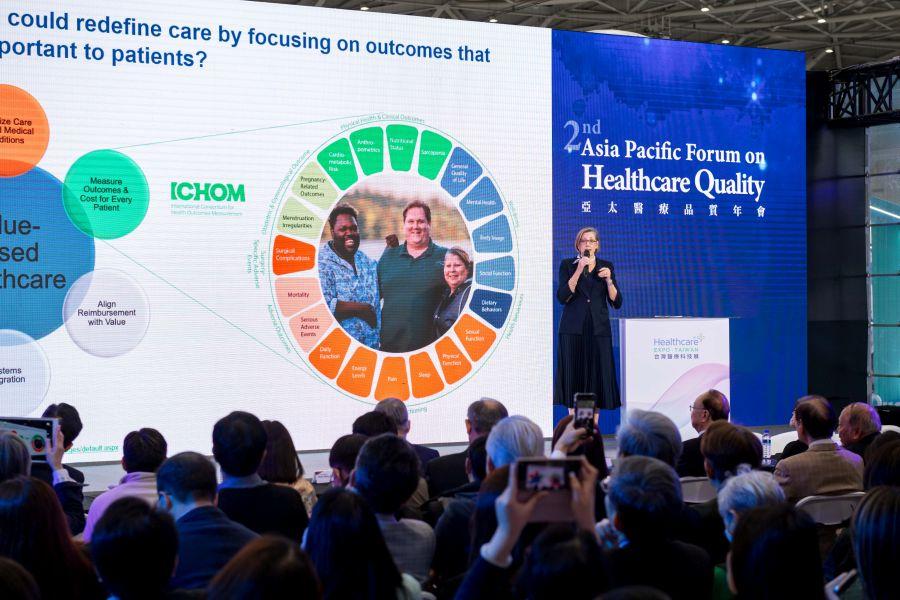
Each measurement set includes baseline patient data, Patient-Reported Outcome Measures (PROMs), data sources, validation tools, and data collection time points. The purpose is to ensure comparability across countries and healthcare systems.
Bright also shared international case studies to demonstrate that patient outcomes are the foundation of both quality improvement and cost control.
At Germany’s Martini Klinik, an academic center affiliated with the University of Hamburg, approximately 2,500 prostatectomies are performed each year. While five-year survival rates were comparable to the national average, patients were particularly concerned about functional outcomes such as urinary incontinence and erectile dysfunction. After adopting PROMs, the hospital eliminated lower-performing surgical approaches, leading to significant improvements in patients’ quality of life. Today, 122 medical centers in Germany have adopted ICHOM measurement tools.
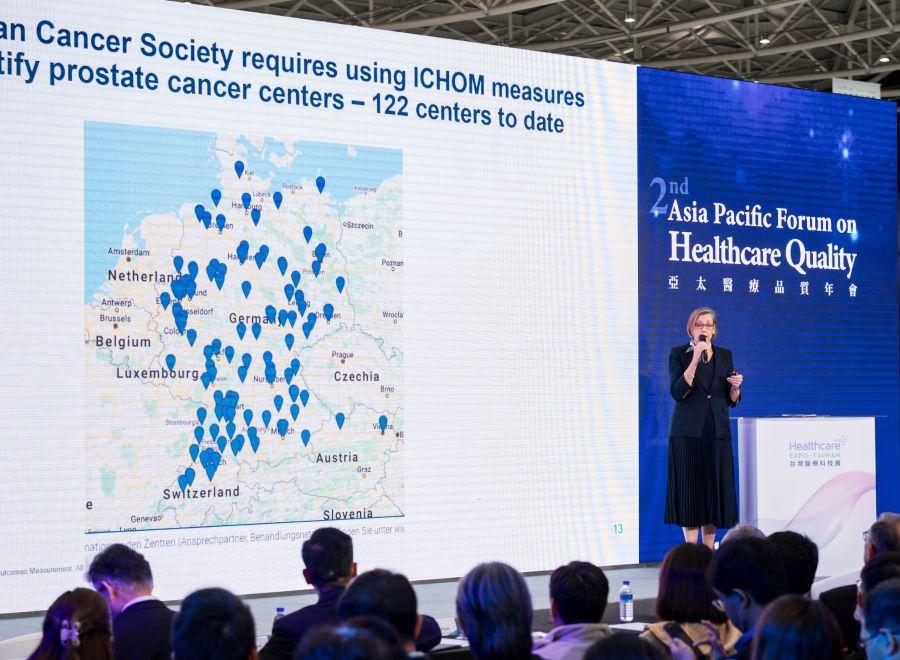
In Mexico, the diabetes care organization CaiPaDi reduced per-patient care costs by nearly 80 percent after implementing ICHOM standards. Anxiety among patients fell by 50 percent, while clinical indicators such as blood glucose, blood pressure, and low-density lipoprotein (LDL) cholesterol levels also moved toward normal ranges.
Bright also cited examples from Ghana and Zimbabwe, where healthcare providers successfully tracked maternal and diabetes-related patient-reported outcomes despite limited resources. These cases, she emphasized, show that even in resource-constrained settings, it is possible to improve both healthcare quality and quality of life.
SNQ as a Key Platform for PROMs in Taiwan
Bright noted that the Safety and Quality Mark (SNQ), Taiwan’s original quality certification system, has evaluated not only structure and process but also outcomes that include patient satisfaction. This aligns consistently with ICHOM’s philosophy and positions SNQ as a vital platform linking Taiwan to the global movement toward patient outcome–driven healthcare.
For healthcare institutions, Bright emphasized that outcome-oriented quality assessment does not need to be implemented all at once. What matters most is to “start small, and simply start.”