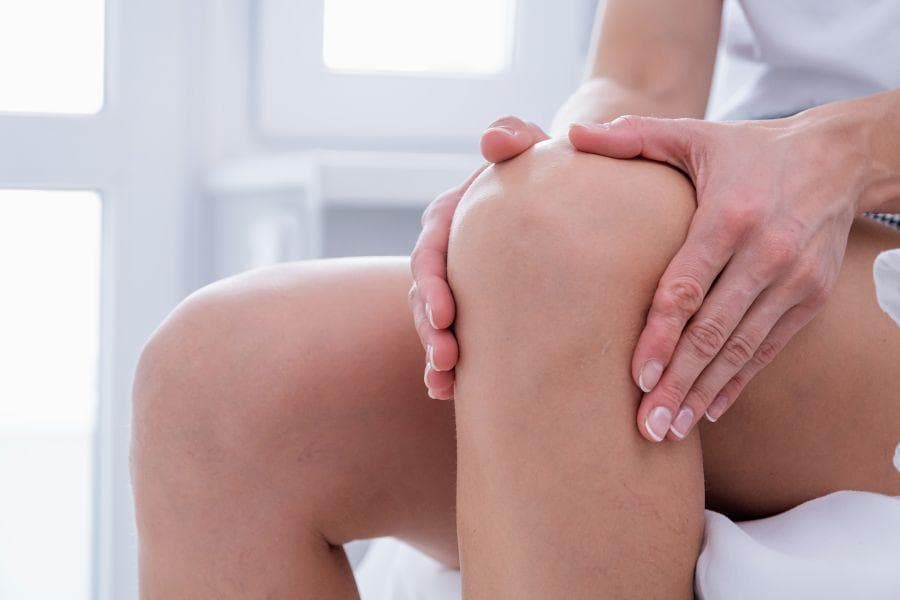
As Taiwan transitions into a super-aged society, approximately 30,000 joint replacement surgeries are performed annually. While the procedure itself has become highly safe, the key lies in preventing potential infection risks during and after surgery.
Linkou Chang Gung Memorial Hospital hosts Taiwan’s first Joint Reconstruction Division within the Department of Orthopedics, focusing specifically on joint replacements. Working in close collaboration with the Orthopedic Nursing Team, they have refined every step from pre-operation to post-operation. This synergy has resulted in a post-operative infection rate of only 0.1%.
Furthermore, pre- and post-operative rehabilitation has significantly reduced the incidence of falls. Within just three days, the team completes pre/post-operative education, surgery, and rehabilitation guidance, allowing patients to return home with peace of mind.
In 2022, Linkou Chang Gung performed approximately 3,000 joint replacements (knees and hips included), ranking among the top in Taiwan. Although joint replacement is a safe procedure with long-term efficacy, infection remains the most significant complication and a primary cause of surgical failure.
Lin Chiu-tzu, a deputy director of the nursing department, noted that if an infection occurs, the patient’s treatment and hospitalization costs can increase sharply. Therefore, the presence or absence of infection in joint replacements is widely regarded as a global benchmark of care quality.
Achieving satisfiable infection control requires accumulating a large volume of cases to analyze risk factors and prevent them in advance. Hu Chih-chien, Director of Joint Reconstruction Division, stated that the medical and nursing team emphasize patients' hygiene, underlying diseases, and nutritional status to ensure that infection risks are minimized.

Pre-Operative: Mastering Risk Factors with Impeccable Disinfection
"We can improve a patient’s condition through the collaborative care of specialists from other departments," Hu explained. For example, patients with poorly controlled diabetes or excessive weight are referred to endocrinologists for management; hemophilia patients receive assistance from hematologists regarding clotting factors. Bleeding before or after surgery can lead to poor wound healing and elevated infection risks. "For high-risk patients, we stabilize these issues before proceeding with surgery."
In addition to identifying risk factors early and adjusting patient health, the Orthopedic Nursing Team has implemented a series of meticulous plans across all stages. Once a patient decides on surgery, nurses provide "skin preparation" education. Nurse Manager Chou Hsiao-yu stated that according to evidence-based literature, patients are instructed three days before surgery to use antibacterial body wash for 10 minutes daily before rinsing.
Upon admission, ward nurses provide a 4% Chlorhexidine Solution. The day before surgery, the patient must scrub their entire body with this solution, focusing on areas with hair such as the scalp, eyebrows, ears, and nostrils to reduce surface bacteria. For knee replacements, nurses perform another thorough disinfection of the surgical site with the 4% solution before the patient is moved to the operating room (OR).
The OR medical team performs sterile disinfection over the largest possible area of the surgical site, specifically targeting knee folds. However, in the past, elevating limbs caused disinfectant to pool on the thighs, potentially leading to redness, blistering, or chemical burns. To prevent this, the nursing team modified the U-shaped surgical drape to wrap circumferentially around the knee. Post-operative assessments of skin integrity and wound care are then conducted to ensure effective protection.

Intra-operative: Disposable Supplies to Lower Infection, Compression Socks to Prevent Swelling
Regarding the intra-operative phase, Hu Chih-chien remarked: "That one hour (of surgery) determines the patient's satisfaction, the complication rate, the success of the surgery, and whether they can use that artificial joint for 30 years."
The surgical environment involves many checkpoints, including cleanliness. This includes regular HEPA filter replacements, testing for dust particles and air quality, and utilizing disposable sterile instruments. OR personnel strictly follow hand-scrubbing disinfection protocols daily. Additionally, before the patient awakens from anesthesia, the nursing team applies anti-embolism stockings to prevent thrombosis and下肢 swelling-induced pain.
"When all these checkpoints are linked together, the infection rate can be controlled effectively," said Hu. "This is the result of the entire team’s effort; the nursing team has been an immense help."
Post-operative: Simulating the Home Environment to Prevent Falls
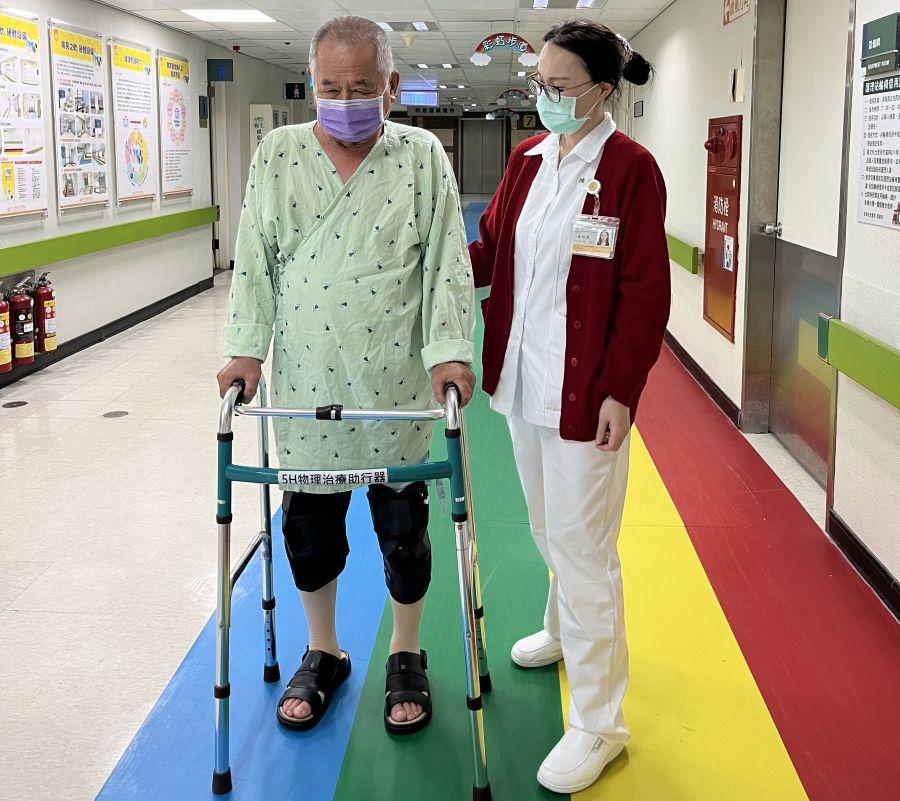
Most patients seeking knee replacements are seniors. To ensure they can return home by the third day of admission, the nursing team initiates rehabilitation early. Nurse Manager Lo Chia-yi mentioned that elderly patients may be too exhausted to get out of bed immediately after anesthesia or may struggle to understand rehabilitation instructions.
"For patients who cannot leave their bed within four hours of returning to the ward, we teach them to use our self-developed 'bedside pedal shoe' to perform resistance exercises while lying down."
Furthermore, to prevent seniors from falling due to unfamiliarity with their new joint, Linkou Chang Gung established the "Guli (Encouragement) Station," designed to mimic a home environment. Assistant Nurse Manager Fan Po-hsin explained that patients practice at least three scenarios before discharge: first, getting in and out of a car; second, sitting on various chairs, such as stools, hard chairs, or sofas; and third, using a standard 40–45 cm toilet. The team provides guidance on standing, sitting, lying down, and even dressing in front of a mirror based on the patient’s mobility and habits.
Case Managers: The Bridge of Communication
A top-tier joint replacement team requires more than just surgical excellence; it needs pre- and post-operative guidance from a nursing team, where case managers play a vital role. Lin Chiu-tzu described case managers as the bridge between doctors and patients, answering inquiries on the "Joint Care Express" LINE@ regarding insurance, materials, wound care, and rehab.
Facing the concerns of families and patients, Case Manager Lu Yu-ting said: “I simply treat them like family. I share success stories to build their confidence because many patients delay surgery out of fear until their joints are severely deformed.”
The collaboration between the Nursing Department and the Joint Reconstruction Division has established a robust care process over the past four years. Kuo Chen-chan thanked the specialist physicians for their willingness to communicate. "Good is never enough" remains the core philosophy driving the team forward.
Editor’s Note: This team is the Silver Award winner of the 25th National Biotechnology and Medical Care Quality Award (2022) in the Nursing Specialty Care category. All titles and positions mentioned reflect the interviewees’ roles at the time of the interviews.