Newsweek-Ranked Hospitals Share Smart Transformation Strategies
Three of Asia’s most prestigious medical institutions, Singapore General Hospital (SGH), The University of Tokyo Hospital (UTH), and Taichung Veterans General Hospital (VGHTC), are redefining both global and local standards of healthcare by integrating smart technologies, precision medicine, and specialized workforce training into their core clinical missions.
All three of them were recently recognized among Newsweek’s World’s Best Hospitals, with SGH ranking ninth and The University of Tokyo Hospital ranking 16th globally. VGHTC was also ranked 85th in Newsweek’s World’s Best Smart Hospitals.
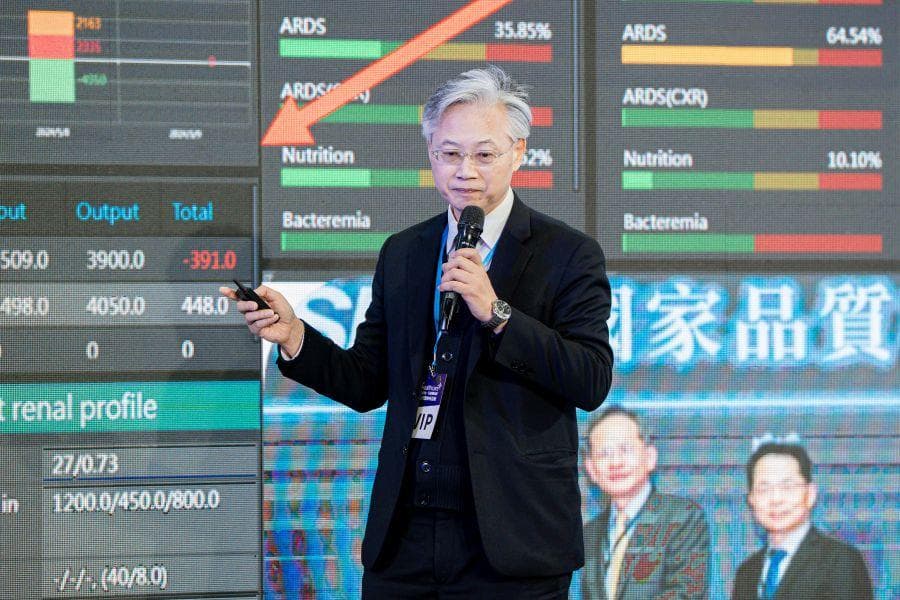
At the recent Asia-Pacific Healthcare Quality Forum, SGH, UTH, and VGHTC highlighted shared approaches to how artificial intelligence has helped redistribute clinical workloads, improve patient care quality, and expand their capacity to serve local communities while supporting medical education and training beyond their immediate regions.
UTH Uses Both Japan-Made hinotori and da Vinci Robotic Systems
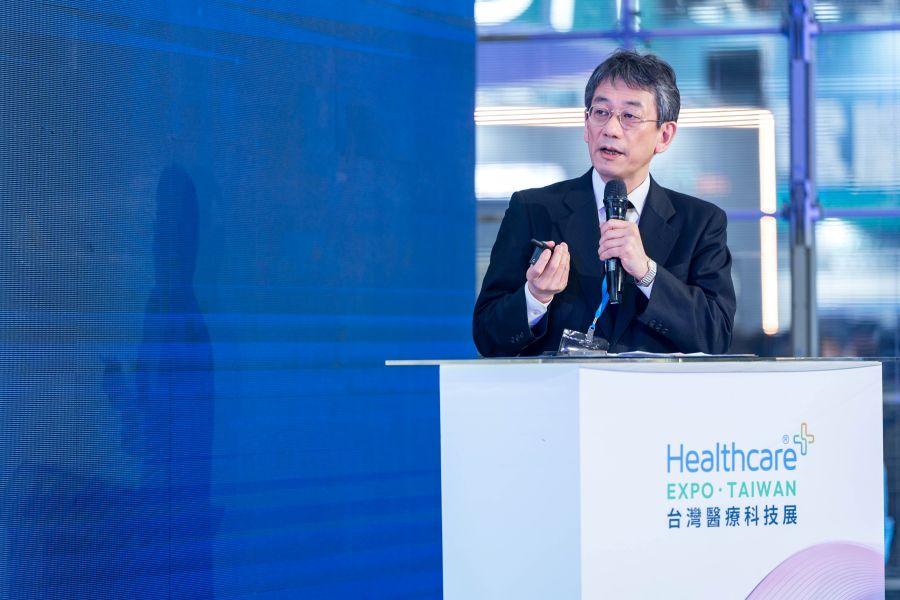
UTH is actively driving medical transformation by leveraging rapid advances in robotic surgery and artificial intelligence. Hospital Director Sakae Tanaka said the institution has introduced three minimally invasive surgical support robotic systems. Two of them are the fourth-generation da Vinci Xi surgical robot and hinotori, a robotic system developed in Japan. The dual-system approach enables surgical procedures to be performed with greater precision and safety.
In addition, UTH has implemented AI-assisted diagnostic imaging systems to help physicians interpret medical images more efficiently, improve the quality of clinical decision-making, and accelerate early disease detection.
In addition, UTH's Department of Clinical Genomics has progressed in the area of precision cancer treatment. One of the key achievements is the GenMineTOP® Cancer Genome Profiling System.
“This system enables simultaneous DNA and RNA analysis, allowing for a more comprehensive understanding of cancer-related genetic alterations,” Tanaka said. GenMineTOP® was officially approved for coverage under Japan’s national health insurance system in August 2023 and is used for precision treatment in both adult and pediatric cancers.
To support long-term medical research, UTH has established a BioResource Center that collects and manages blood samples and surgical tissue specimens with patient consent and in accordance with ethical guidelines.
SGH Deploys Robotic Process Automation to Cut Tens of Thousands of Workloads
SGH has introduced Robotic Process Automation (RPA) to streamline operations, reducing manual workload and generating substantial productivity gains.
SGH CEO Tan Hiang Khoon said that with RPA, the hospital has freed more than 84,000 man-hours, generating up to S$3 million in productivity gains.
In clinical practice, SGH has developed its own AI-powered medical documentation tool, NoteBuddy, which automatically transcribes and summarizes conversations between doctors and patients in real time. The tool reduces documentation labor work and allows clinicians to pay more attention to patient communication.
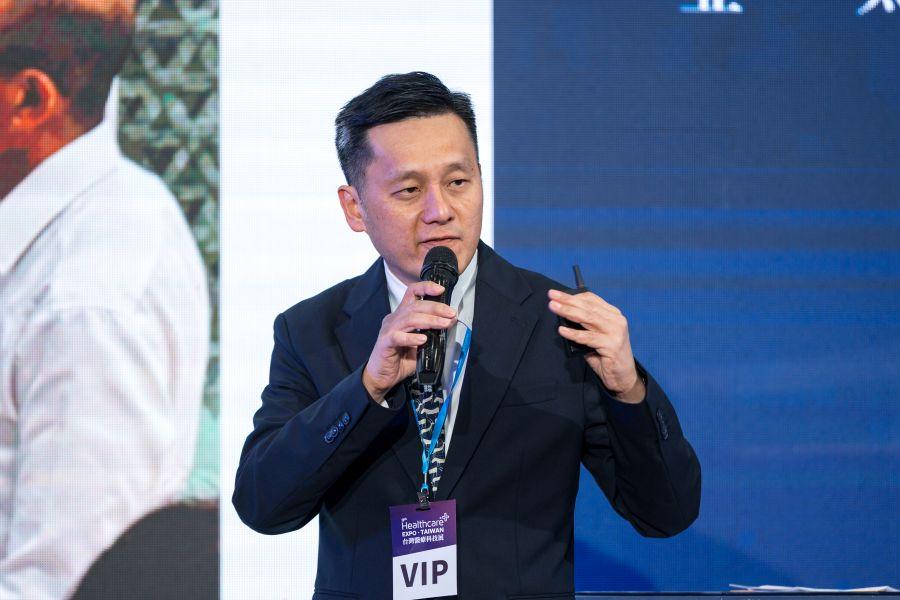
Tan also introduced the uSINE®, the world’s first AI-powered ultrasound-guided spinal landmark identification system for anesthesia, developed in Singapore. MedClarity has improved efficiency by simplifying coronary CT scan workflows, reducing processing time to one-tenth of previous levels.
SGH has further addressed clinical needs in precision medicine through the Individualized Antibiotic Combination Test (iACT). Tan said the test, developed by SGH’s pharmacy department, identifies optimal antibiotic combinations for multidrug-resistant infections within 48 hours and covers more than 99 percent of clinical bacterial strains.
Medical innovation at SGH is supported by the Alice Lee Innovation Centre of Excellence (A.L.I.C.E.), which helps clinicians translate frontline observations into practical applications and, in some cases, commercially viable solutions.
VGHTC Applies AI Pain Assessment, Nursing Robots, and Scaled Telemedicine
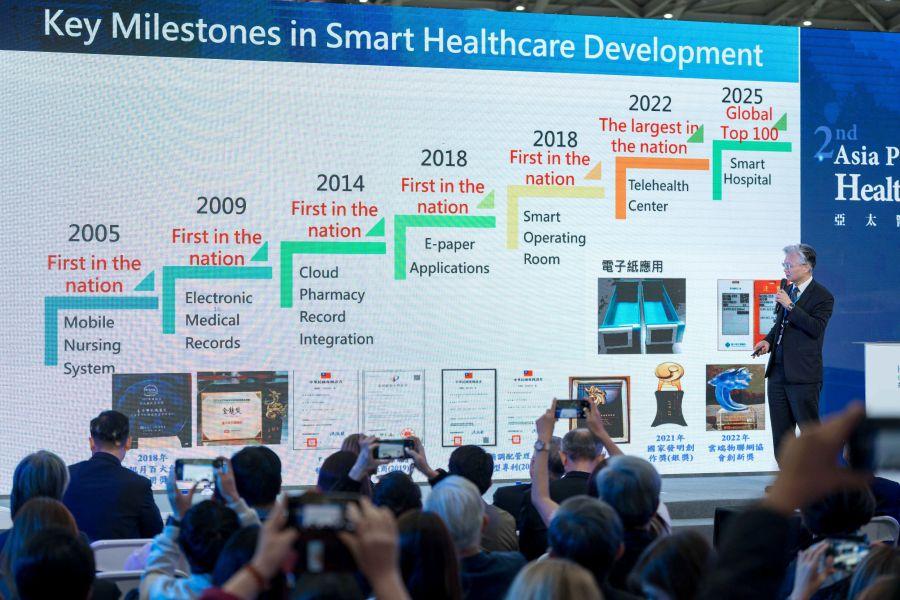
VGHTC has expanded the use of AI, robotics, and telemedicine to improve patient care across central Taiwan. Superintendent Yun-Ching Fu, who also serves as Vice President of National Chung Hsing University, reviewed the hospital’s smart healthcare development at the annual forum. Since developing Taiwan’s first mobile nursing system in 2005, VGHTC has built on two decades of innovation and was ranked 85th globally in Newsweek’s World’s Best Smart Hospitals 2026.
VGHTC has partnered with Tunghai University to develop an AI-based pain level recognition system to accelerate triage and patient flow in emergency departments. Fu said the system has achieved an accuracy of 99.9 percent. By analyzing facial expressions, the system categorizes patients into three levels—no pain, mild pain, and severe pain—and provides corresponding clinical recommendations, ranging from observation to immediate intervention.
Beyond emergency care, VGHTC collaborated with Foxconn to launch a nursing robot named “Nurabot” in March 2025. The robot is expected to reduce nursing workload by approximately 30 percent.
Advancing Healthcare by Linking Global Talents, Local Integration, and “Bilingual Thinking"
Despite rapid technological advances, hospitals in Japan, Singapore, and Taiwan agree that the long-term future of healthcare ultimately depends on talent development and the ability of organizations to sustain continuous learning.
UTH has identified the training of healthcare professionals as a core mission. With support from Japan’s Ministry of Education under the Advanced Medical Personnel Training Base Formation Project, the hospital offers clinical observership and hands-on training opportunities for foreign physicians.
SGH shifted from a traditional command-based hierarchy to a “team of teams” model that emphasizes cross-disciplinary collaboration, transparency, and trust. Tan said SGH is actively cultivating so-called “bilingual thinkers” referring to professionals fluent in both healthcare and technology. Through pathways such as the Clinician Innovator Award (CIA), SGH encourages frontline staff to co-design, test, and implement solutions to everyday clinical challenges.
As a major medical center in central Taiwan, VGHTC plays a key role in regional healthcare integration and care coordination. The hospital collaborates with 26 healthcare institutions across the Taichung, Changhua, and Nantou regions, providing services that include clinical and operational support, teleconsultation, remote health monitoring, and home-based medical care.
Amid global trends of healthcare workforce shortages, rising care costs, and a growing emphasis on patient-centered care, Japan, Singapore, and Taiwan are steadily building future healthcare systems that balance safety, efficiency, and responsiveness to patient needs.